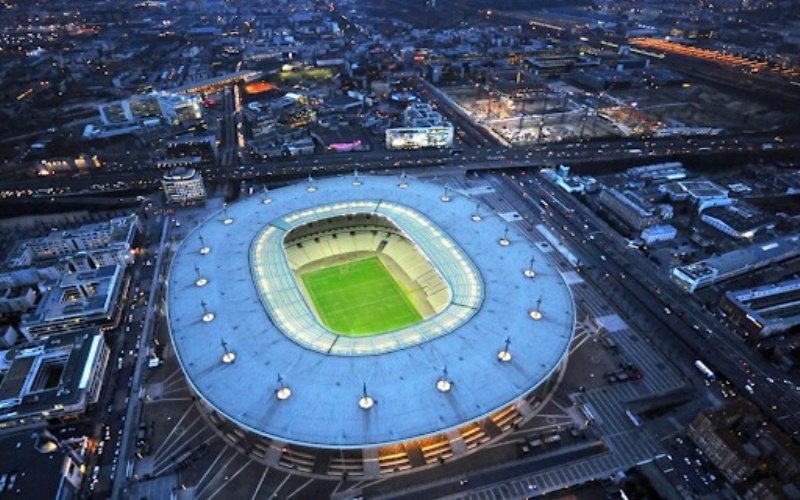
Located in Saint-Denis, just north of Paris, this magnificent arena stands as the crown jewel of French sporting infrastructure. According to in-depth research by Xoilac, History of Stade de France Stadium is defined by its construction for the 1998 FIFA World Cup and its evolution into a multi-purpose powerhouse. From football championships to Olympic athletics, it remains the stage where national heroes are forged and the world’s greatest athletes gather to make history.
The Legendary Legacy and History of Stade de France Stadium
A Glimpse into the History of Stade de France Stadium
The journey began in the early 1990s when France was selected to host the 1998 FIFA World Cup. The government realized that the existing venues were insufficient for a modern global tournament. Construction started in 1995, and the project was completed in just 31 months. This rapid development is a significant chapter in the unique History of Stade de France Stadium, showcasing French engineering prowess. The stadium was officially inaugurated on January 28, 1998, with a friendly football match between France and Spain, where Zinedine Zidane scored the very first goal on this hallowed pitch.
Designed with a signature elliptical roof that appears to float above the stands, the venue was built to accommodate over 80,000 spectators. Unlike many other European grounds, it was intended to be the home of both the national football team and the national rugby team. This dual-purpose identity has been an integral part of the History of Stade de France Stadium, making it a symbol of national unity and athletic excellence for all French citizens.
Zidane and the First World Cup Title
The summer of 1998 remains the most golden period in the stadium’s timeline. It hosted the final match where “Les Bleus” faced Brazil. Zinedine Zidane’s two iconic headers and Emmanuel Petit’s late strike secured a 3-0 victory, giving France its first-ever World Cup star. The image of the French flag projected onto the Arc de Triomphe and the roar of the crowd in Saint-Denis are forever etched into the documented History of Stade de France Stadium, marking the moment the arena became a national monument.
Architectural Innovation and Flexible Design
One of the most remarkable technical aspects of the venue is its movable stands. To accommodate track and field events, a portion of the lower seating can be retracted to reveal an athletics track. This flexibility has allowed the venue to host the 2003 World Athletics Championships and, more recently, serve as the centerpiece for the Paris 2024 Olympic Games. Such versatility ensures that the History of Stade de France Stadium is not limited to football but spans the entire spectrum of professional sports.
The roof itself is a marvel, designed to protect spectators from the elements while leaving the grass pitch exposed to natural sunlight. Throughout the decades, several renovations have kept the facility at the cutting edge of technology, including high-definition screens and improved hospitality suites. These upgrades have allowed the stadium to maintain its UEFA Category 4 status, ensuring it remains a top-tier choice for the world’s most prestigious sporting governing bodies.
Hosting the Champions League and Major Finals
Beyond international football, the stadium has become a frequent host for the UEFA Champions League finals. It has witnessed some of the most dramatic moments in club football, including Real Madrid’s triumphs and intense clashes between Europe’s elite. Every time the Champions League anthem echoes through the stands, another layer is added to the History of Stade de France Stadium. The venue’s ability to provide a neutral yet electric atmosphere makes it a favorite for “Final Eight” scenarios and high-stakes domestic cup finals like the Coupe de France.
Furthermore, the stadium has welcomed legends of the music industry. From The Rolling Stones to Beyoncé, the arena has transformed into a concert hall for the world’s biggest tours. These entertainment spectacles have broadened the cultural impact of the venue, proving that its legacy extends far beyond the final whistle of a football match or a rugby scrum.
Read more on Xoilac TV https://www.barpleiades.com/lich-thi-dau/
Conclusion
In conclusion, the venue has surpassed its original purpose to become a global icon of sport and culture. From the unforgettable night in 1998 when France conquered the world to its recent role in the 2024 Olympics, the History of Stade de France Stadium is a testament to the power of competition and collective celebration. It has successfully bridged the gap between traditional sports and modern entertainment.